2026-10-03 · Ryan Mitchell
Why Upstairs Rooms Stay Hot in Bixby Homes and How to Fix Them
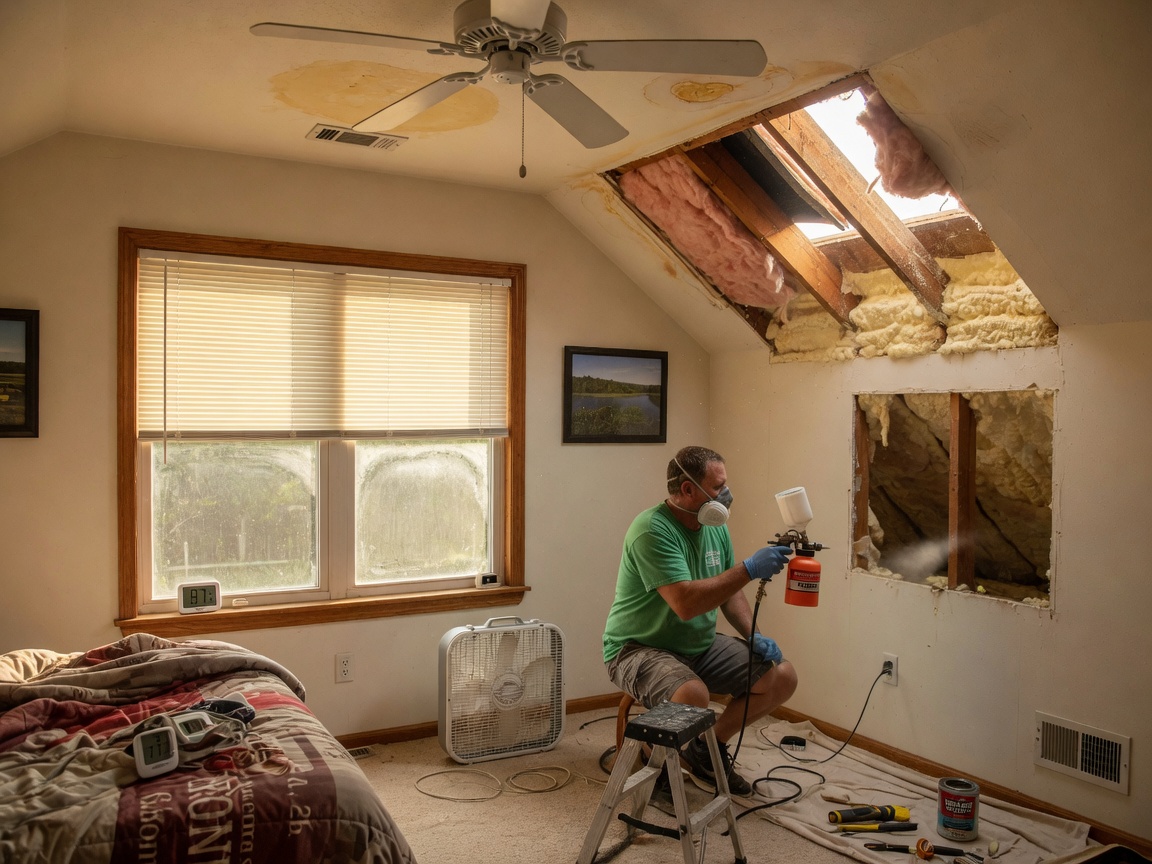
Upstairs rooms in Bixby homes stay hot primarily because most attics have insufficient insulation at the ceiling plane, letting roof heat transfer directly into living spaces during the humid subtropical summers. This issue shows up consistently in neighborhoods such as Bixby Ranch Estates and South Bixby where many homes built before 2005 have R-19 or less in the attic floor. Applying closed-cell spray foam directly to the underside of the roof deck stops that transfer and can lower upstairs temperatures by 8–12 degrees on peak summer days.
Heat Transfer Patterns in Bixby Summers
Bixby’s hot summers push attic temperatures above 130 degrees when the roof deck has no air seal. Heat moves downward through standard fiberglass batts or blown cellulose because those materials allow air movement around penetrations and at the eaves. In The Village at Ashton Creek, two-story homes with vaulted ceilings see the problem worsen because the insulation sits flat on the ceiling while the roof deck radiates heat straight into the rooms below. Closed-cell spray foam adheres to the deck, eliminates those gaps, and adds an R-value of roughly 6.5 per inch so the entire assembly stays cooler. Homeowners near Washington Irving Memorial Park report the difference most after the first summer because the foam also blocks the mild winter drafts that otherwise force HVAC systems to run longer.
Housing Stock and Attic Conditions Across Tulsa County
Many homes in South Bixby and nearby Jenks feature vented attics with 12–18 inches of loose-fill insulation that has settled or been disturbed by HVAC work. These setups perform poorly once summer humidity enters through soffit vents and condenses on cooler surfaces. The same pattern appears in Broken Arrow subdivisions where pole barns and metal buildings sit close to residences, adding radiant heat load. Switching to roof-deck insulation changes the attic into a conditioned space that no longer pulls heat into upstairs bedrooms. This approach works especially well on the split-level homes common along 131st Street because it avoids compressing existing insulation or blocking recessed lights.
How Closed-Cell Spray Foam Solves the Problem
Closed-cell spray foam expands to fill every gap at the roof deck, rafters, and penetrations, creating a continuous thermal and air barrier. In Bixby Ranch Estates homes with multiple HVAC systems, this single upgrade often allows the upstairs unit to cycle less because the attic no longer acts as a heat sink. The material also adds structural rigidity to the roof assembly, which helps during occasional high-wind events. Homeowners can expect the foam to maintain performance for the life of the structure without settling or degrading. For vaulted ceiling areas, the same product fills the rafter bays completely, eliminating the dead air space that otherwise traps heat.
See the detailed comparison in Insulating Vaulted Ceilings in Bixby Custom Homes: Why Closed-Cell Foam Works Best for specific rafter-depth recommendations. Readers considering whole-home upgrades can review Is Attic Spray Foam Worth It for a Large Bixby Home With Multiple HVAC Systems? to understand payback timelines based on local utility rates.