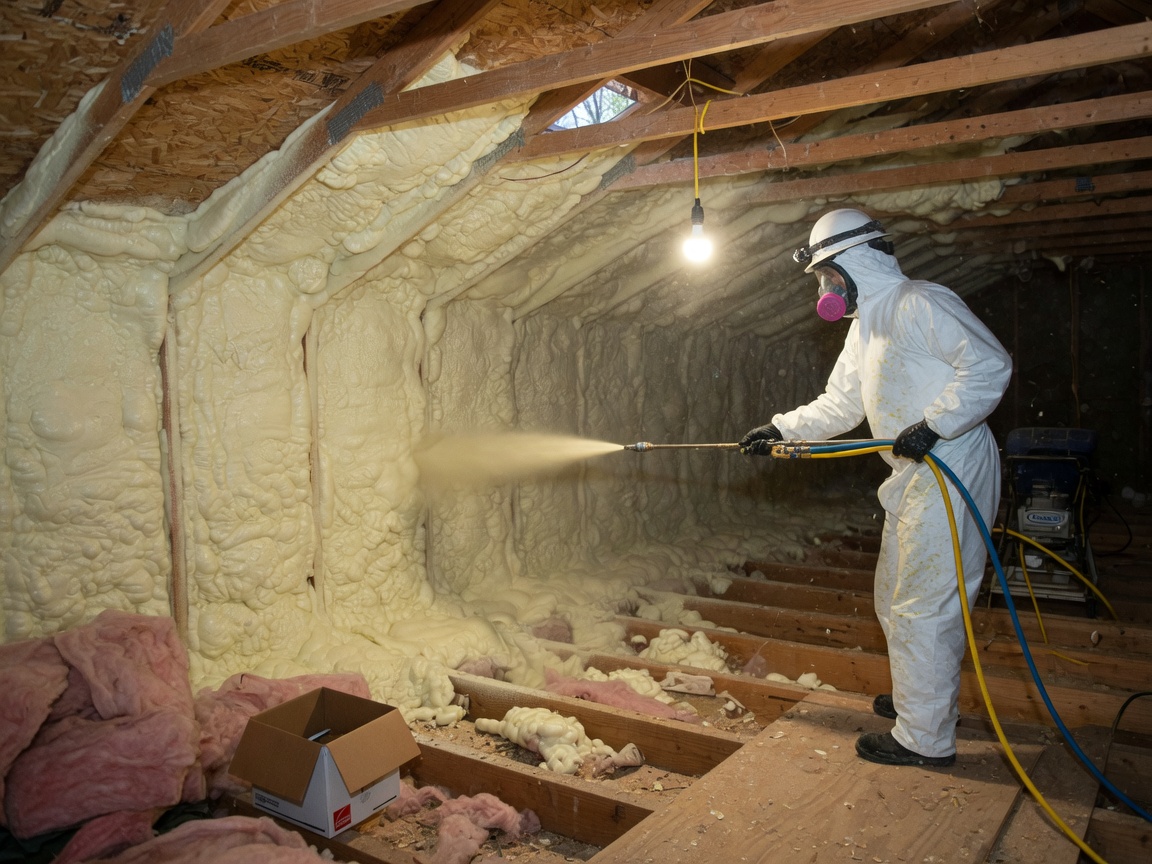
Closed-cell spray foam creates a rigid barrier with an R-value around 6.5 to 7 per inch that also blocks air and moisture movement. In Bixby’s humid subtropical climate, hot summers drive high humidity that can push moisture into attics and wall cavities of homes built in the 1980s and 1990s around The Village at Ashton Creek. The material’s closed structure prevents condensation on roof decks during mild winter temperature swings common in Tulsa County.
Application requires precise mixing ratios and substrate temperatures above 50 degrees to avoid poor adhesion on older plywood or OSB sheathing found in South Bixby properties. Technicians must account for the area’s clay-heavy soils that retain moisture after heavy rains, which raises crawl-space humidity levels and makes closed-cell the preferred choice over open-cell in those spaces. Proper ventilation planning around Bixby Sports Complex-area homes prevents trapping residual moisture from nearby creek drainage.
Local building practices in Jenks and Broken Arrow often include cathedral ceilings that need full-depth closed-cell fills to meet energy codes without adding bulk. Edge cases include sealing around existing knob-and-tube wiring in pre-1970 homes near Washington Irving Memorial Park, where the foam must be applied in thin lifts to avoid overheating the conductors. Homeowners should inspect for hidden roof leaks before installation because the foam will trap any ongoing water intrusion against the decking.
Technician insight
In Bixby the thing that catches most people out with closed-cell spray foam is the clay soil around South Bixby foundations that holds moisture long after rain stops. Homeowners in Bixby Ranch Estates often seal the attic but leave the rim joists open, so humidity still migrates up from the crawl space during our long humid summers.
Moisture issue in South Bixby crawl space
A homeowner noticed musty air and higher cooling bills in a 1990s home near the Bixby Sports Complex. Inspection showed open soil and standing water after spring rains. Closed-cell foam was applied to the rim joists and floor decking after grading the ground and adding a vapor barrier. The musty smell disappeared and the crawl space stayed dry through the following summer.
Closed-Cell Spray Foam Insulation Services We Offer
✓Attic Insulation
Closed-cell spray foam applied to attic floors and rafters to reduce heat gain during Bixby summers and limit winter heat loss in single-story ranch homes.
✓Crawl Space Encapsulation
Full coverage of floor joists and rim boards with closed-cell foam to block ground moisture rising from Tulsa County clay soils common in South Bixby.
✓Wall Cavity Insulation
Injection of closed-cell foam into existing exterior walls of homes in Bixby Ranch Estates to improve sound control and stop air leakage at window and door frames.
✓Rim Joist Sealing
Targeted closed-cell application along the band board where basements meet the foundation, addressing cold air infiltration typical in The Village at Ashton Creek properties.
✓Cathedral Ceiling Insulation
Spray application between rafters in vaulted ceilings to prevent ice dam formation during Bixby’s occasional winter freezes while maintaining roof ventilation paths.
Closed-Cell Spray Foam Insulation Cost in Bixby, OK
| Service | Typical Range | What Affects It |
|---|---|---|
| Attic floor application | $1.80–$2.60 per sq ft | Price rises with roof pitch and number of recessed lights to protect. |
| Crawl space walls and floor | $2.10–$3.00 per sq ft | Higher range applies when standing water or heavy debris must be removed first. |
| Wall cavity injection | $2.50–$3.50 per sq ft | Varies with stud spacing and whether interior drywall must be removed. |
| Rim joist only | $450–$850 | Flat rate for typical 1,800–2,400 sq ft Bixby ranch homes. |
Ranges are typical for Bixby, OK and confirmed with an exact written quote before any work starts.
How it works
- 1
Site Assessment
Walk through the home in Bixby to measure square footage, check for active leaks, and identify electrical or plumbing runs that need protection before foam application.
- 2
Surface Preparation
Clean dust and debris from joists and sheathing, mask fixtures, and verify substrate temperatures meet product requirements for adhesion in local humidity.
- 3
Foam Application
Apply closed-cell foam in controlled lifts using truck-mounted equipment from the address at 15017 S Grant St, ensuring uniform thickness across attics or crawl spaces.
- 4
Final Inspection
Trim any over-spray, verify coverage depth, and confirm no gaps remain around penetrations before returning the space to the homeowner.
Pricing
Costs depend on square footage, access difficulty, and thickness required; call for a same-day site visit and written quote.